What does a deed look like?
Most deeds run two to four pages, and nearly all of them have the same parts in roughly the same order. Below is a sample from Deedly's deed engine, with fictional names and the legal wording grayed out, and what each numbered part does.
The short answer
A deed is a short typed document, usually a few pages long. It names the person giving the property (the grantor) and the person receiving it (the grantee), describes the land exactly, says what the grantee gave for it, and ends with the grantor's signature and a notary's certificate. Once the county records it, the deed also carries the recorder's stamp.
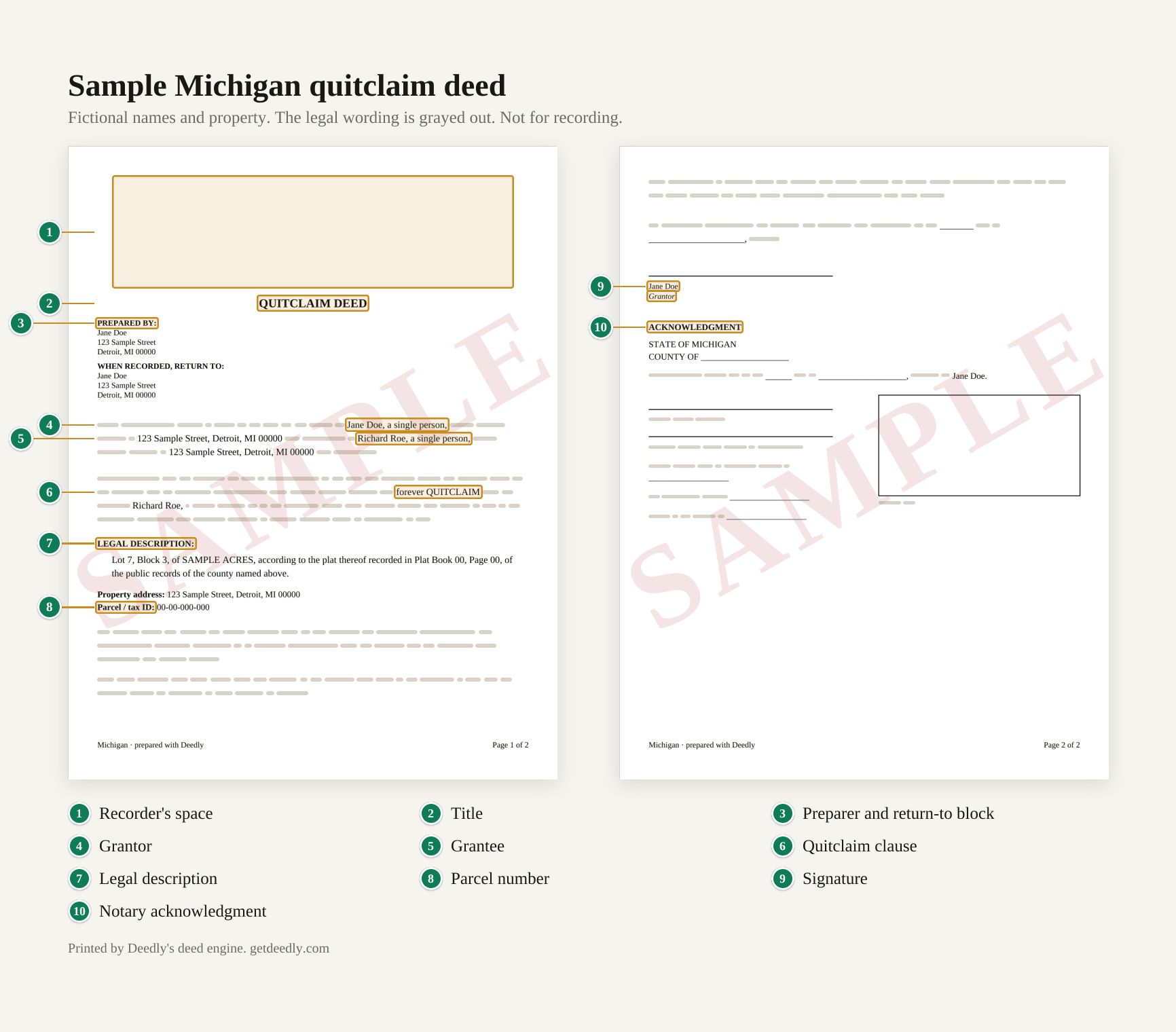
- Recorder's space. Left blank for the recorder's stamp and recording details.
- Title. Names the kind of deed.
- Preparer and return-to block. Who prepared the deed, and where the recorder mails the original once it is recorded.
- Grantor. The current owner, who signs the deed.
- Grantee. The new owner.
- Quitclaim clause. Releases whatever interest the owner has, with no promise about the title.
- Legal description. Identifies the land exactly. A street address is not enough.
- Parcel number. The county's tax identification number for the property.
- Signature. Where the grantor signs.
- Notary acknowledgment. The notary's certificate that the owner appeared and acknowledged signing.
Each part, in order
- Recorder's space. Most states want a blank margin at the top of page one for the recording stamp. It runs from 1 to 3.5 inches, depending on the state, and some states want certain details, such as the return address, placed inside it.
- Preparer and return-to block. Who prepared the deed, and where the recorder mails the original once it is recorded. Many states require the preparer's name and address on the deed.
- Title. Names the kind of deed: quitclaim deed, warranty deed, transfer on death deed and so on.
- Grantor and grantee. The current owner and the new owner, by full legal name, usually with marital status and a mailing address. On a transfer on death deed the people receiving the property are beneficiaries, and they receive nothing until the owner dies.
- Consideration. What the grantee gives for the property: a price, a token amount, or a statement that it is a gift. It matters for transfer tax.
- Words of conveyance. The words that actually move the property. A quitclaim deed releases whatever interest the grantor has. A warranty deed conveys the property and adds promises about the title. A transfer on death deed transfers it only at the owner's death.
- Legal description. The exact description of the land, copied word for word from the prior recorded deed. A street address is not enough.
- Parcel number. The county's tax number for the property. Many recorders want it on page one.
- Signature and witnesses. The grantor signs. In Connecticut, Florida, Georgia, Louisiana, and South Carolina, witnesses must sign too, and some other states require them for particular deeds.
- Notary acknowledgment. The notary's certificate that the grantor appeared and acknowledged signing. Recorders generally will not record a deed without one.
What a recorded deed looks like
After recording, the deed carries the recorder's stamp or label: the recording date and time, a book and page or an instrument number, and the fees paid. Most counties then return the original to the address in the return-to block; a few keep only a scanned copy, or email it back. That stamp is how anyone, from a buyer to a title company, finds the deed in the public record later.
Reading the legal description
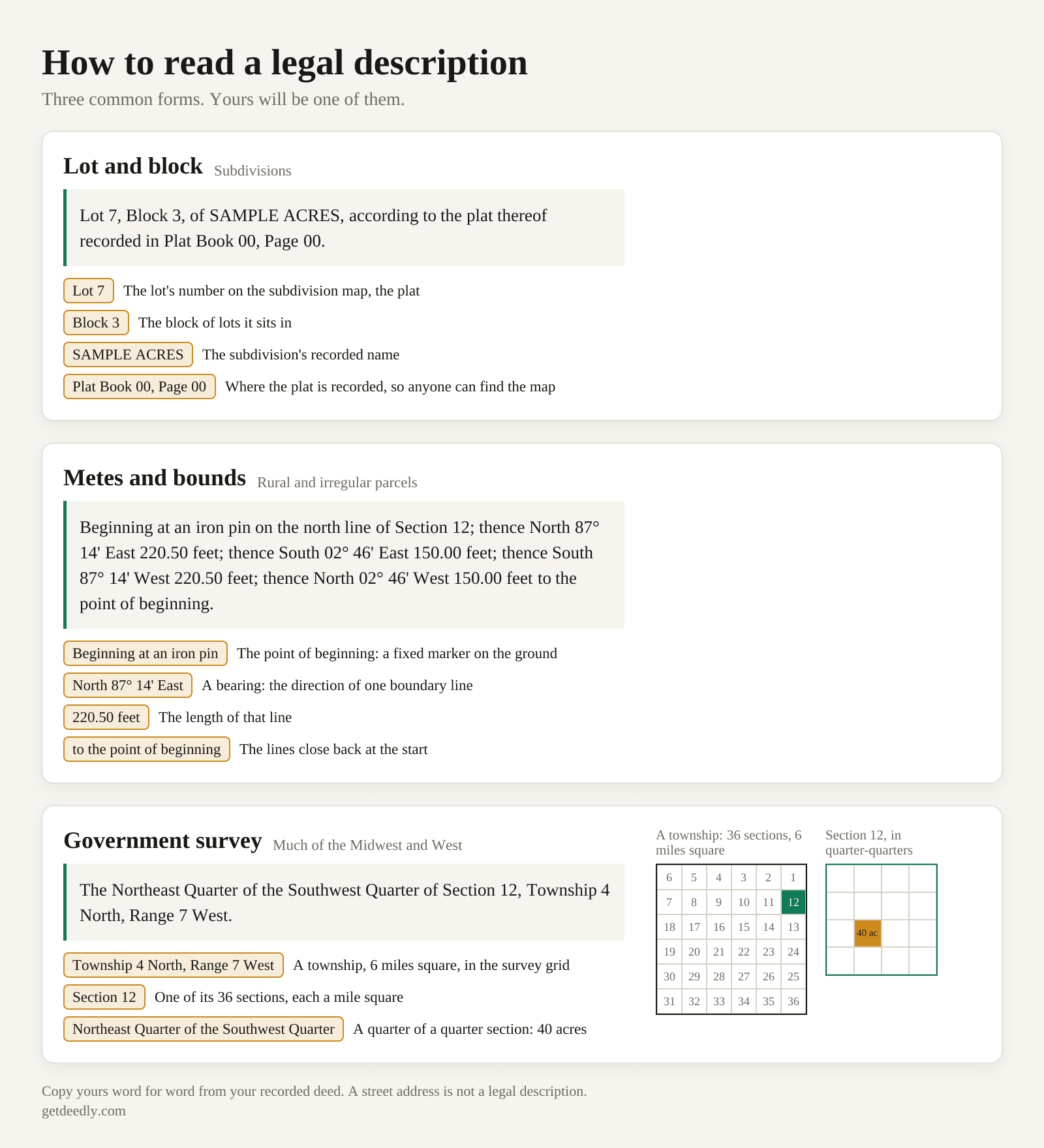
Most legal descriptions take one of three forms. Copy yours exactly as your recorded deed has it, abbreviations and punctuation included.
A sample of each kind of deed
Each deed's page shows a sample, with its parts numbered the same way:
- Quitclaim deed: a Michigan sample
- General warranty deed: a Washington sample
- Special warranty deed: an Arizona sample
- Transfer-on-death deed: a Virginia sample
- Beneficiary deed: a Colorado sample
- Lady bird deed: a Florida sample
- Gift deed: a Missouri sample
Getting a copy of your own deed
Your recorded deed is a public record, kept by the county office that records deeds: the recorder, register of deeds or clerk, depending on the state. Many counties let you search their records online and print a copy, and a certified copy costs a small fee. Find your county's recording office.
Answer a few questions, then read the finished document before you pay.
Common questions
Most are two to four pages. A long legal description can be attached as an exhibit, which adds a page or more, and some states have forms that travel with the deed, such as a transfer tax declaration.
To be recorded, yes: recording offices generally require the grantor's signature to be acknowledged before a notary. Connecticut, Florida, Georgia, Louisiana, and South Carolina also require witnesses.
Title is ownership itself. A deed is the document that transfers it from one owner to the next. When people say they have the title to their house, the paper they mean is usually the recorded deed.
Keep reading
Deedly is not a law firm
Its software and documents are not a substitute for the advice of an attorney. We provide self-help software and state-specific deed forms; you make your own decisions about your property. Using Deedly does not create an attorney-client relationship, and nothing here is legal advice. If your situation is complex or contested, talk to a licensed attorney in your state.